NVC Level-2 & 3 Fashion Designing
Introduction
Fashion designing is an art to create dresses aesthetically and culturally. It has more sections to work such as accessories.
The global Fashion industry is a product of modern age. Prior to mid nineteenth century most of the clothing was custom made. Handmade for individual, that could be ordered by tailors or dressmakers. By the beginning of the 20th century with the rise of new technologies such as the sewing machine, the rise of global capitalism and the development of the factory system of production clothing had increasingly come to be mass-produced in standard sizes and sold at fixed prices.
Fashion industry in Pakistan is witnessing fast growth. There are numerous luxurious fashion brands in the country and their annual sales volume runs in billions of rupees. It is an exceedingly competitive market. Pakistan’s fashion industry has become a very integral part of the operations of e-commerce businesses. It has helped to contribute a great deal to the revenues and profits of online businesses.
Pakistani society and government are eager to establish the growing demand of the apparel. New academia is being established and an environment is creating to produce skilled and equipped experts to match with pace of global fashion industry. It is a highly skill-based industry, professional training is imperative to its development. The standards of the education and training programmes are practicing to considerable extent. With the gradual emergence of a knowledge-based society, more effective flow of information and more sophisticated consumers, the industry has seen a burgeoning demand for professional fashion designers. in this specific competency standards, all basic subjects are being discussed such as drawing, stitching, patron making, knitting, marketing, entrepreneurship, fashion illustration and embroidery.
Purpose of training program
The purpose of this training program is to give a thorough understanding and skills of the Textile/ Fashion sector with special reference to Fashion Designing in one-year training programmed to the trainee. The Textile/ Fashion industry needs skilled labor for meeting the national and international standards. It is, therefore, important to address the need for a multidisciplinary approach to meet the challenges within the sector. Upon successful completion of this course, the trainee should be able to:
- Core elements and the development of the Fashion designing process
- Give an account of essentials to Textile Fashion industry and the future of this industry
- Demonstrate an understanding of different Fashion designing traits.
- Point out relevant industry stakeholders & their roles in driving innovation in Fashion Designing
- Improve the professional competence of the trainees
- Provide opportunities for recognition of skills attained through non-formal or informal pathways
- Enhance Textile Fashion Industry activities at regional/provincial/national levels through a better approach.
Overall objectives of the training course
The primary objective of this training program is to provide the trainees with up-to-date knowledge and skills required by the Textiles sector with special reference to building Fashion Designing in 1-year training program in a comprehensive way to cope with the challenges of the Fashion Industry. After qualifying for the course at different levels (Level 2&3), the trainees will be able to get job in Textile Fashion Industry and able to perform as entrepreneurs. The contents of the course are specifically designed in such a way that it covers all the major areas of design in Textile/ Fashion sector of Pakistan.
The overall objectives of developing this qualification are to:
- Improve the overall quality of training delivery and set national benchmarks for training of Junior Fashion Designer (Level 2&3) in the country
- Provide flexible and progressive learning opportunities for trainees to receive relevant and up-to-date skills in the Textiles
- Provide basis for competency-based assessment which is recognized and accepted by employers in modern days
- Establish standardized and sustainable training in consultation with the Textile & Fashion Industry.
Competencies to be gained after completion of course
After completing this course, the trainee will be capable of performing different activities in Textile & Fashion Industry especially supervision effectively. Furthermore, this skilled training program enables the trainee to develop multispectral competencies such as creative thinking, problem solving, research skills, personal and group management, presentation and communication skills, technical and professional negotiations related to Textile & Fashion Industry. The below listed competencies imprinted by this training program are quite prominent to the trainees’ profile to enhance their employability in their career in textile fashion industry:
- Knowledge and concepts of supervision and management in the Textile & Fashion Industry
- Creative thinking and troubleshooting skills in the Textiles & Fashion
- Potential to translate theoretical knowledge into practice
- Identify and explore potential areas of opportunities in the Textile Sector
- Develop strategies to maintain the quality and safety of the workplace
- Time management, working in teams and conflict handling among co-workers
- Safe and secure use of workplace tools, techniques and materials at worksites
- Digital documentation and effective communication skills
- Working on commercial setups and meeting the timelines
Job Opportunities Available Immediately and in The Future
The successful pass out of this course may avail entrepreneurial opportunities and/ or fetch job/ employment in textile fashion sectors as supervisor.
Trainee Entry Level
Entry requirement for this qualification is Matric or equivalent with basic knowledge of Computer
Minimum Qualification of Trainer
DAE in Fashion Designing with 5 years of relevant experience
Bachelors in Home Economics with 3 years of relevant experience
Bachelors in Garment Manufacturing/ Textiles Designing with 2 years of relevant experience
Recommended trainer trainee ratio
The recommended trainer and trainee ratio per class is 1:25
Medium of instruction
Urdu, English, Sindhi or Local Language
Overall objective of the course
The overall objective of this programme is to produce employable computer operators who can provide computer operating services in nearly any industry or organization, which involves computer in its operations. The graduates of this programme will also be able to be entrepreneurs. However, this will require providing additional input on entrepreneurship development for the one who is willing to start his/her own business. (Not included in the curriculum).
The structure of this course
This curriculum comprises 24 modules. The recommended delivery time is 605 hours. Delivery of the course can therefore be full time, 5 days a week, for 6 months.
Job opportunities available immediately and in the future
The successful pass out of this course may avail entrepreneurial opportunities and/or fetch job/employment in beauty industry beautician,Junior Make-up artist, junior hair dresser, junior skin therapist and junior spa therapist.
Trainee entry level
Entry requirements for this qualification are minimum Middle or Equivalent
Recommended trainer trainee ratio
The recommended trainer and trainee ratio per class is 1:25
Medium of instruction
Urdu, English or Local Language
Diploma in Information Technology
Diploma in Information Technology Training Objectives
The course aims on producing the trained workforce in the field of Information Technology to fulfill employment requirement of I.T. industry not only in the country but also abroad. The curriculum is divided into two academic semesters. The curriculum of Semester-I is designed to train the students to work as database developer and manage the offices. The curriculum of semester-II is designed to train the students in the field of E-commerce and interactive web development.
Curriculum Salient
Name: Diploma in Information Technology
Entry Level: Matric or Equivalent
Duration: One Year (Two Semesters)
Total Training Hours: 1000 Hours (500 Hours per Semester)
Schedule of Classes: In a week05 Days / Week, In a day05 Hours Daily, Total Duration
Medium of Training: Sindhi / Urdu / English
Passing Marks: 50 %
Faculty Qualification: BS(CS/IT) or Graduation & One Year Diploma in Information Technology with at least 05 years teaching experience.

Diploma in Information Technology
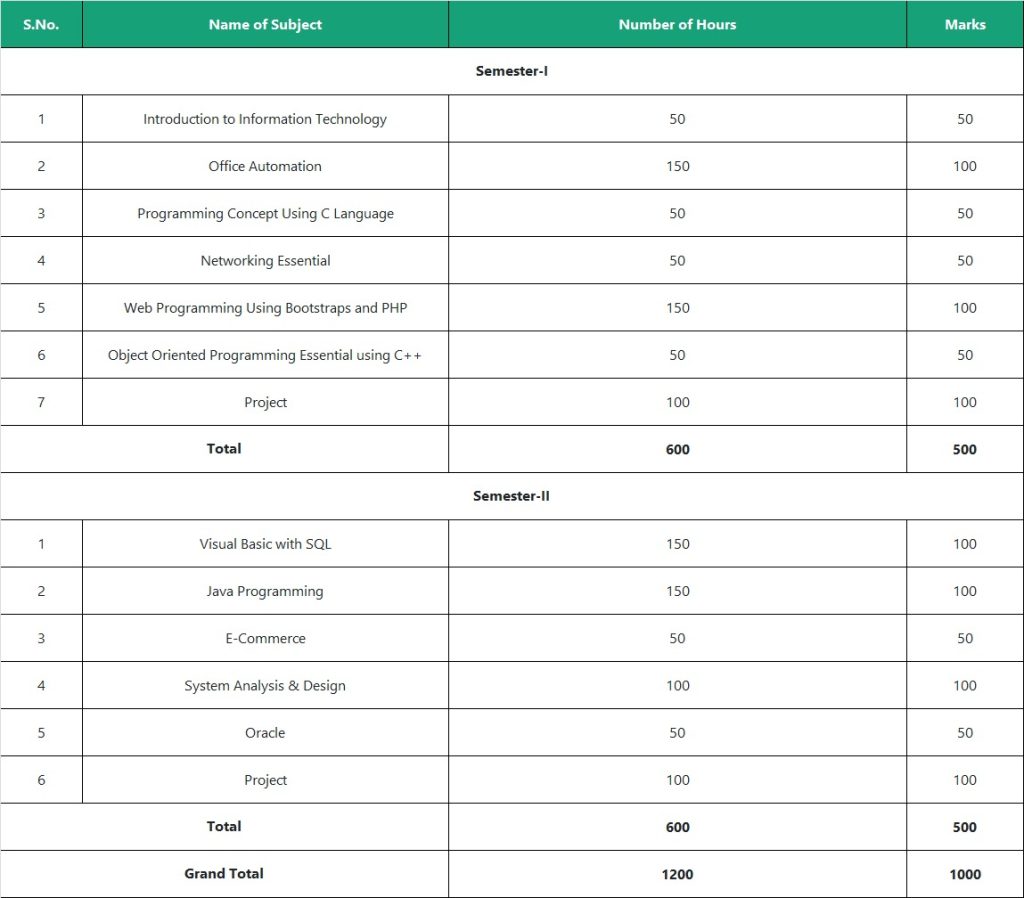
List of Subjects with Hours & Marks Distribution.
Life on Campus
Take a glimpse into our vibrant student community